
A small business cybersecurity strategy should cover seven fundamental things: tested backups, protection against malware, secure phones and tablets, strong passwords with multi-factor authentication, staff awareness of phishing, a written incident plan, and a regular review of who has access to what.
The UK National Cyber Security Centre (NCSC) builds its small organisation guidance around the same core areas, and most of the actions take minutes rather than days.
The good news is that you don't need a large budget or a security team to get started. You need a short-written plan, named owners and a habit of checking it.
Why does a small business need a cybersecurity strategy?
Size won't protect you. Small businesses are targeted at a similar rate to larger ones. The UK Cyber Security Breaches Survey 2025/2026 found that 43% of UK businesses reported a cyber breach or attack in the previous 12 months, including 42% of micro businesses and 46% of small businesses. Phishing was the most common type, experienced by 38% of businesses. (Source: GOV.UK)
Ransomware was far less common, at 1% of businesses in the same survey, down from 3% in each of the two previous years. Bear in mind that the survey only counts breaches that organisations identified and were willing to report, so the true figures may be higher.
A strategy matters because most incidents start with ordinary weaknesses: a reused password, an unpatched laptop or a convincing email.
What are the essential parts of a small business cybersecurity strategy?
Here's a simple way to break it down, with an owner for each area:
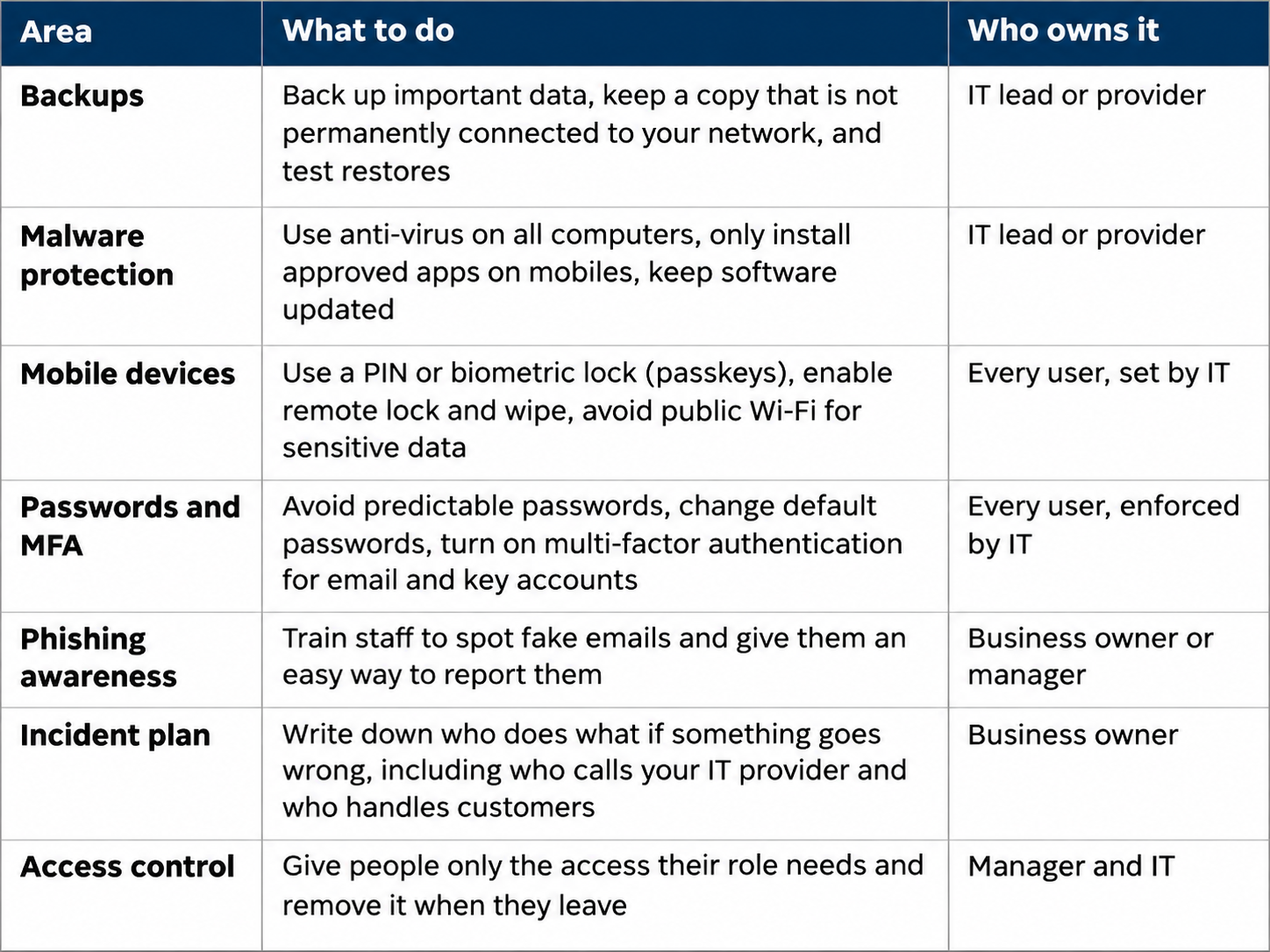
These areas follow the NCSC Small Business Guide, which covers backups, malware, mobile devices, passwords and phishing.
How should a small business handle backups, passwords and updates?
Start with the three controls that prevent the most damage.
Backups. The NCSC advises working out what needs backing up, taking regular copies and testing that you can actually restore them. Keep the backup device separate from the original, so ransomware can't reach both.
Passwords and MFA. Steer clear of predictable passwords such as family or pet names and change the default passwords that devices ship with. Switch on two-factor authentication for important accounts like email and banking.
Updates. Turn on automatic updates. Cyber Essentials requires that updates fixing critical or high-risk vulnerabilities are applied within 14 days of release, and that unsupported software is removed.
Is Cyber Essentials worth it for a small business?
Cyber Essentials is the minimum standard the UK Government recommends for organisations of all sizes. It checks five technical controls: firewalls, secure configuration, security update management, user access control and malware protection.
The basic certificate is a verified self-assessment, signed off by a board member or equivalent. Fees are tiered by size, starting at £320 plus VAT for micro-organisations (0 to 9 employees) and rising to £440 plus VAT for small organisations (10 to 49 employees). Cyber Essentials Plus adds an independent technical audit and is quoted individually.
It's well worth considering if customers or tenders ask for it. Even if they don't, working through the five controls gives you a practical checklist.
What should staff training cover?
Cyber security awareness for your team is key since over 90% of cyber-attacks target employees and are successful through human error. So, put it in place, keep it short and repeat it often. Security Awareness Training & Testing (SATT) is a great place to start. It covers how to spot phishing (odd sender addresses, poor spelling, unexpected requests), how to report a suspicious email, password policies and the risks of public Wi-Fi.
One more thing: the NCSC advises against punishing staff who get caught out. If people fear blame, they're less likely to speak up early, and that's when speed matters most.
Cyber security awareness training arms your employees with the skills required to protect your business network from targeted cyber-attacks. Working to actively minimise risks by increasing general cyber security awareness and best practices surrounding your business network, you’ll benefit from a cyber confident workforce and customers who trust you to keep their personal information safe.
What should be in a cyber incident plan?
Aim for one page. Include who to call first, how to isolate affected devices, where your backups are held, and who speaks to customers.
If personal data is involved, UK GDPR applies. A reportable personal data breach must be reported to the ICO without undue delay and within 72 hours of becoming aware of it. The clock starts when you discover the breach, not when it happened. Keep a log of every breach, whether or not you report it.
Do check the current version of the ICO guidance before you finalise your plan, as the ICO says some of it is under review following the Data (Use and Access) Act.
How does a managed IT and security provider help?
Writing the strategy is the easy part. Running it every day is where small teams struggle: patching devices, monitoring for threats, testing backups and responding out of hours.
Focus Group is a UK independent provider of business telecoms, connectivity, IT, cyber security and mobile solutions. It researches, deploys and operates these services around the clock, so your cyber security and IT can be run by one accountable partner rather than managed in pieces.
If you'd like a second opinion on your current setup, a short review against the checklist above is a sensible first step.
FAQs
How much should a small business spend on cybersecurity?
There's no single correct figure. Many NCSC actions, such as turning on MFA, enabling automatic updates and testing backups, cost little or nothing. Spend more as your data, customer obligations and number of staff grow.
Is anti-virus enough?
No. Anti-virus is one control. Backups, patching, MFA, access control and trained staff each cover risks it doesn't.
Do I need Cyber Essentials?
It's not a legal requirement for most businesses, but it is the Government-recommended baseline and some customers require it.
What is the first thing to do if I think I have been hacked?
Isolate affected devices, change passwords, contact your IT provider and start an incident log. If personal data is involved, assess whether you must report to the ICO within 72 hours. The NCSC also publishes response and recovery guidance.
Who should own cybersecurity in a small business?
Someone senior should be accountable, but the NCSC stresses that cyber security is everyone's business and shouldn't rest with one person.